








Preparation for birth begins with knowledge about the pregnancy. Whether it's acupressure to prepare for birth, a course with a midwife, medical tests, yoga or long conversations with people you trust: When a baby is expected, things change and everyone deals with it differently. If it is the first time that one creates new life oneself, many enter a previously hidden world according to their feeling. A new preoccupation with one's own body and often also completely unknown sensations pave their way over many months until the birth.
In this article I, Anni from the Shakti Team, share my very personal experiences with birth preparation through acupressure and with the Shakti Mat. This is my story, it doesn't have to be yours. But you may feel invited to take something from it if you wish.
"Amid all these things, don't forget that no one knows your body and the life growing inside it better than you do."
Antje Wickboldt
Content
2. Here's how I used acupressure to prepare for childbirth starting in the 38th week of pregnancy
3. Breathing, Focus, and More: What Else Helped Me Besides Acupressure
Why acupressure only from SSW 38? The birth is imminent!
During pregnancy, the body becomes very sensitive to physical and emotional influences. For this reason, acupressure can trigger significantly stronger physical reactions in people like me, who already have a lot of experience with it, than you would expect from your own, non-pregnant body. Because pregnancies are so extremely individual, it is therefore important to always discuss with your midwife or doctor whether certain exercises and ideas that you would like to try are helpful or perhaps even unfavorable for your own situation. Such a consultation does not mean that the other person can or should decide about your body, but it does give you the opportunity to make a better-informed decision yourself.
An acupressure mat and pressure applied to specific acupressure points can strongly stimulate the body. For some people, both can induce labor during pregnancy. This is why there are no official recommendations for using the mat during pregnancy, as there is a complete lack of research on how often it can trigger premature labor.
That's why I only started using the Shakti Mat intensively every day after the end of the 37th week of pregnancy, because from this point onwards my child was always welcome. The combination of acupressure from the 38th week of pregnancy and walks helped my pelvis to dilate in good time and allow the baby to slide deep into the birthing position.


Here's how I used acupressure to prepare for childbirth starting at 38 weeks gestation
Below, I’d like to share with you the exercises that have personally helped me the most. For tips that aren’t so specific to one person, feel free to check out the article Acupressure and Pregnancy on our site, which takes a more general look at the topic and summarizes a few specific ideas for acupressure points during pregnancy and childbirth.
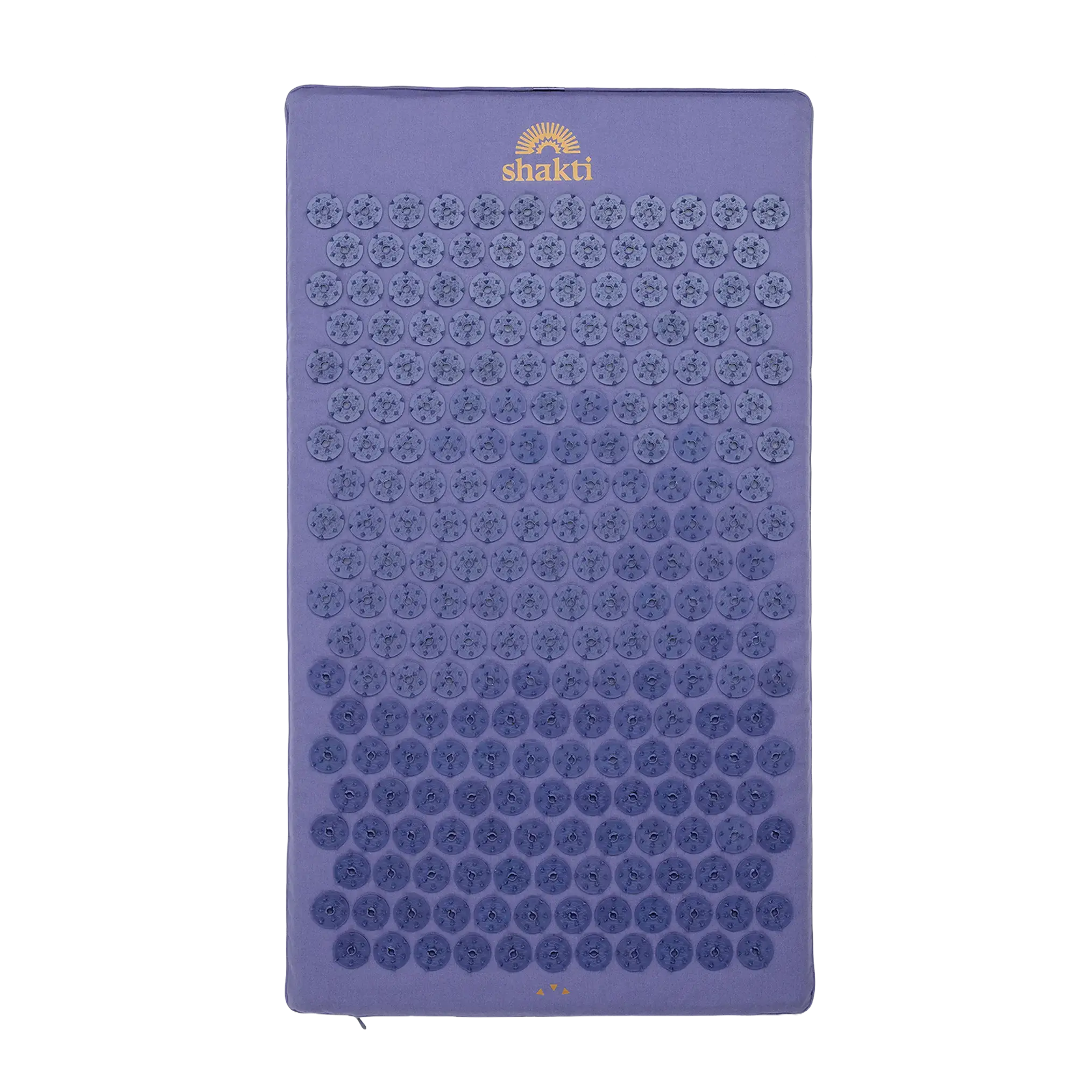
In preparation for the birth, the Shakti Mat became like a good friend to me, who waited for me every day and gave me the signal: now is the time for me and the child in my belly. I didn't let a single day go by without acupressure until the birth. Not out of pure ambition or because I had written it into my schedule, but simply because it was so good for me.
Calf relaxation: support the bladder and relieve cramps
Towards the end of my pregnancy, my bladder was often very tight because there was a lot of weight on it. As I knew that calf cramps and a tight bladder are mutually beneficial, I decided to let the bladder be a bladder and try to release all the tension in my calves.
The effect was quickly noticeable! I leaned back in bed or on the fold-out sofa for about 10 minutes a day with an audio book or podcast on my ears and let my bare calves get really heavy on the Shakti Mat. Some days I just sat there for the whole 10 minutes, others I tilted my feet to the left and right and towards and away from each other like little windshield wipers to create a massage effect for my calves. It was heavenly to get up afterwards when everything was really loose and full of blood! And indeed: my bladder also relaxed much better from then on.
Daily yoga (anything from 5 to 40 minutes was fine for me, depending on how I felt that day) also helped me a lot in preparing for childbirth. My favorite exercise was definitely the deep squat, which I practiced for about 1–2 minutes every day starting at the beginning of my pregnancy.

Neck pillow for loose muscles to evening & morning
In addition to the acupressure mat, I also used the neck pillow very intensively every day - I even started using it earlier, around the 35th week of pregnancy. Due to the change in weight distribution and the softening and tilting of the pelvis towards the end of pregnancy, I often experienced a pulling pressure in my neck.
To counteract this, I rested my neck against the neck pillowfor about five minutes every morning and evening, sometimes even longer. The advantage is that this not only relaxed my neck but also my jaw muscles, which can be very helpful during childbirth. It’s no coincidence that a common piece of advice from midwives is: “Relaxed up top = relaxed down below.”
Even with the neck pillow, I sometimes modified the exercise for myself so that I performed an active massage by gently turning or rocking my head back and forth. This is really pleasant, especially after a long day, and helped me a lot as I was still very physically active until the end of my pregnancy and worked a lot in the garden.
Supporting the Pelvis - Active Acupressure
Initially without a mat, but with my hands, I also supported my pelvis and rump daily with pleasant pressure. For this I placed my hands, as you can see in the picture, so that my thumbs could press into the soft upper tissue of my gluteal muscles as well as further up on the hip and pelvic bones.
My acupressure to prepare the pelvis for birth was always varied: I kept looking for the tense spots.
I didn't stick to specific acupressure points, but felt for tense or painful areas every day (often several times a day). I applied gentle pressure here, while I bent my knees slightly with my legs slightly wider than shoulder-width apart and let my pelvis circle first five times to the left, then five times to the right. I then looked for the next tense spot and repeated the exercise for as long as I felt like it. The closer I got to the birth, the more time I spent doing this exercise, as it really made my pelvic area feel much lighter and also seemed to help the baby slide deeper. It was important for me to always stand with my knees slightly bent to make room for the natural tilting movement of my pelvis and not to work against it.
Acupressure from SSW 39 - direct energy downwards to the end: Stimulation of the feet
In both Indian Ayurveda and Traditional Chinese Medicine, we hear a lot about the so-called flow of energies through the body. During childbirth and to stimulate its beginning, there was of course a very clear direction in which I wanted to direct my energy: downwards.
So I started acupressure for my feet at the end of week 38 of pregnancy, initially sitting on the edge of the bed and carefully stamping on the Shakti Mat, applying a little more pressure each day until I was finally able to stand on the mat with my full weight. It's better to start slowly, after all, your feet carry a lot more weight during pregnancy. Even for experienced Shakti Mat fans, this can result in a completely new, intense feeling.
Throughout this process, I always made sure not to overexert myself and only did the exercise for as long as it felt comfortable. I never looked at the clock—I’d say I spent anywhere from 30 seconds to 8 minutes on the mat. During the foot exercises, I always opened the window wide, draped a blanket around my shoulders, focused on my deep breathing, and actively imagined how the flow of energy from my head toward my feet was gently cradling my baby. That might sound a little esoteric, but it really helped me prepare for the birth and give space to all the processes happening in my body without tensing up against them.

Breathing, focus & co.: What else helped me besides acupressure
In addition to taking care of my body physically so close to the birth, breathing and focusing emotionally on the upcoming event were especially important to me. There are many breathing exercises recommended for childbirth, and personally, I don’t feel that you should simply “memorize” them. Instead, it helped me to consciously choose situations where I could experiment to see which breathing techniques elicited a positive response in me. For example, if you’re sitting on the toilet trying to relieve constipation, you can make excellent use of that situation to practice letting go through breathing using various techniques you’re familiar with.
For me personally, the breathing technique I chose was this: I breathe deeply into my abdomen and consciously imagine that all my sphincter muscles completely relax as I inhale, so that I am open downward. I maintain this feeling of openness and do not tense up again. As I exhale, my abdomen draws in and up (as if I were trying to pull my navel upward), and at the same time, I gently but purposefully push downward with my upper abdominal muscles. I repeat this exercise for as long as I can maintain my concentration. As soon as I notice that I’m tensing up or losing focus, I stop and continue practicing another time.
Daily yoga (anything from 5 to 40 minutes was fine for me, depending on how I felt that day) also helped me a lot in preparing for childbirth. My favorite exercise was definitely the deep squat, which I practiced for about 1–2 minutes every day starting at the beginning of my pregnancy.
I also find it helpful to really take the time every day (for example, in the morning and at night) to prepare myself emotionally for the existential and once-in-a-lifetime experience that lies ahead. Every birth is unique. I liked to sit cross-legged or lie on my side with my hands on my belly, feeling the movements or the stillness of the little life inside me, and actively letting myself feel whatever thoughts arose about the birth, the postpartum period, and becoming a mother. Most of the time, I was delighted that thoughts of anticipation dominated—but of course, that’s not always the case. If something seemed unresolved to me, I’d make a mental note of it for later or voice it aloud right then and there. Afterward, I’d discuss any fears or unresolved concerns that had come up with someone I trusted, or I’d read up on certain topics again if I didn’t feel sufficiently informed.
During your pregnancy and birth preparation, you may come across well-intentioned advice, read articles like this one or get news from a pregnancy app. Don't forget that no one knows your body and the life growing inside it better than you. You decide what's right for you. You decide what your path is. And no one can tell you what you want to take from all this information, what steps you want to take next and what you can feel good about. You decide.
I wish you a wonderful journey towards the birth.
If you'd like to discuss acupressure and acupressure mats for childbirth preparation, share tips with other expectant mothers, or ask questions, feel free to visit our group on Facebook.
